

Donald Trump got knocked around in court and in his own house this week when he attacked the First Amendment by banning three outlets from the White House. But it wasn’t the first time he effed around, or the first time he found out. This is the Trump press ban origin story you’ve been waiting for.
Most of our members probably already know at least the broad strokes, but this week has brought it all rushing back, and it’s worth remembering how Jim Acosta helped deliver a smackdown to Trump that took him years to get over. If the educational value isn’t enough for you, well, it’s just good fun too.
But first, we have to go back a little bit further, because we all know that Trump has never liked tough questions (or even just plain legitimate ones) and so he took a dislike to Jim Acosta long before the blowout that resulted in the ill-fated ban.
Here’s Trump in May of 2016 revealing his early onset Acosta Derangement Syndrome, telling Acosta “I've watched you on television, you're a real beauty” when Acosta challenged him about transparency.
And after he won in 2017, Trump attacked CNN during his first press conference as president-elect, so Acosta challenged him to take a question from him. Trump lashed out, but Acosta stood his ground.
That’s just a small taste of the many times Trump and his goons bristled under questioning from Acosta, who refused to back down.
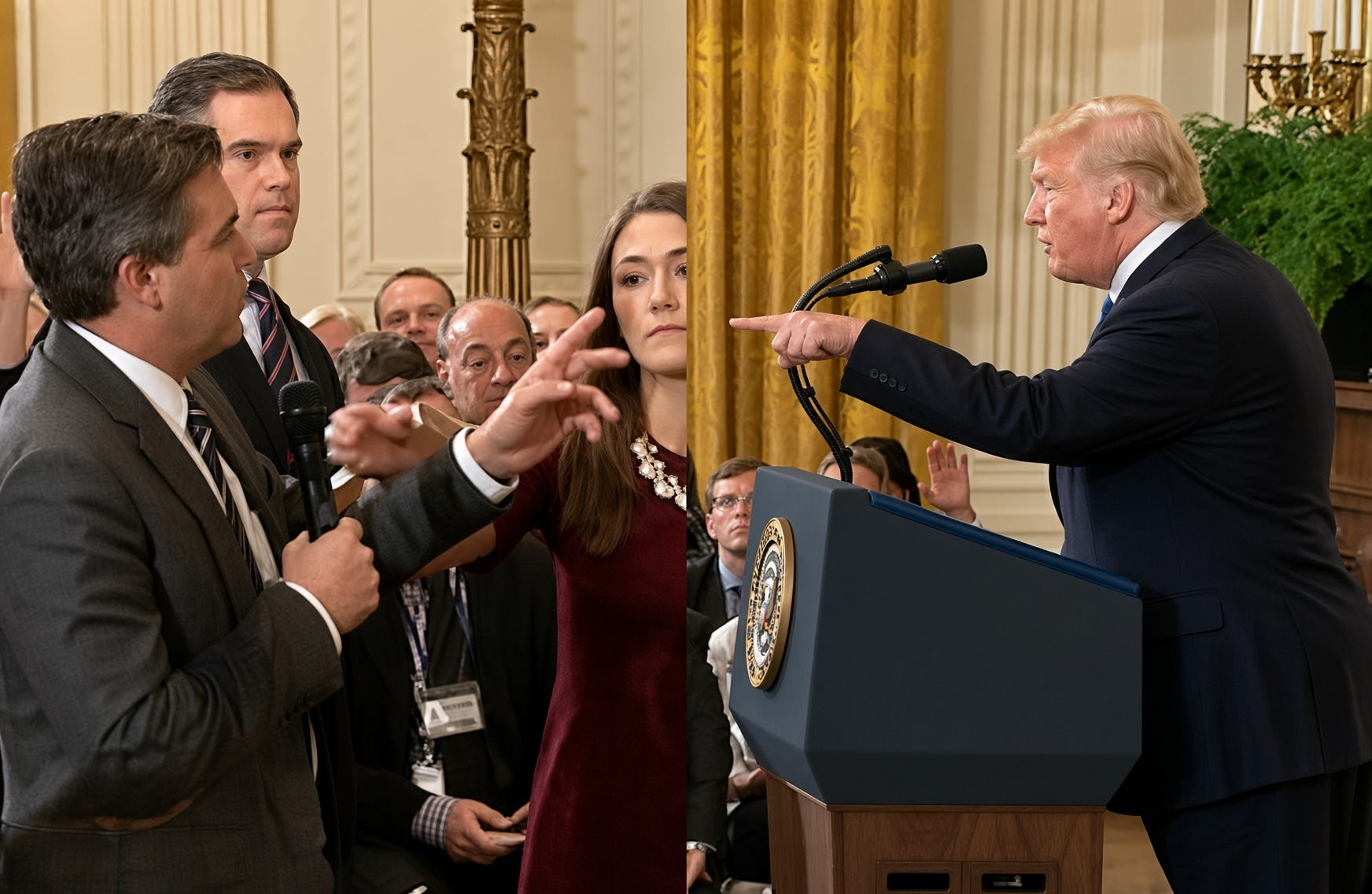
And so it was that Trump, in a foul mood after the 2018 midterms, found himself getting hammered by Acosta on his racist campaign and impending indictments in the Russia scandal.
When Trump flipped out, Acosta refused to back down, and refused to relinquish his mic when Trump ordered it confiscated.
JIM ACOSTA: Okay. Thank you, Mr. President. I wanted to challenge you on one of the statements that you made in the tail end of the campaign in the midterms, that this —
DONALD TRUMP: Here we go.
JIM ACOSTA: Well, if you don’t mind, Mr. President —
DONALD TRUMP: Let’s go. Let’s go. Come on.
JIM ACOSTA: That this caravan was an “invasion.” As you know, Mr. President —
DONALD TRUMP: I consider it to be an invasion.
JIM ACOSTA: As you know, Mr. President, the caravan was not an invasion. It’s a group of migrants moving up from Central America towards the border with the U.S.
DONALD TRUMP: Thank you for telling me that. I appreciate it.
JIM ACOSTA: Why did you characterize it as such? And —
DONALD TRUMP: Because I consider it an invasion. You and I have a difference of opinion.
JIM ACOSTA: But do you think that you demonized immigrants in this election —
DONALD TRUMP: Not at all. No, not at all.
JIM ACOSTA: — to try to keep —
DONALD TRUMP: I want them — I want them to come into the country, but they have to come in legally. You know, they have to come in, Jim, through a process. I want it to be a process.
And I want people to come in. And we need the people.
JIM ACOSTA: Right. But your campaign had — your campaign —
DONALD TRUMP: Wait. Wait. Wait. You know why we need the people, don’t you? Because we have hundreds of companies moving in. We need the people.
JIM ACOSTA: Right. But your campaign had an ad showing migrants climbing over walls and so on.
DONALD TRUMP: Well, that’s true. They weren’t actors. They weren’t actors.
JIM ACOSTA: They’re not going to be doing that.
DONALD TRUMP: They weren’t actors. Well, no, it was true. Do you think they were actors? They weren’t actors. They didn’t come from Hollywood. These were — these were people — this was an actual — you know, it happened a few days ago. And —
JIM ACOSTA: They’re hundreds of miles of way though. They’re hundreds and hundreds of miles away.
DONALD TRUMP: You know what?
JIM ACOSTA: That’s not an invasion.
DONALD TRUMP: I think you should — honestly, I think you should let me run the country, you run CNN —
JIM ACOSTA: All right.
DONALD TRUMP: — and if you did it well, your ratings would be much better.
JIM ACOSTA: But let me ask, if I — if I may ask one other question —
DONALD TRUMP: Okay, that’s enough.
JIM ACOSTA: Mr. President, if I may — if I may ask one other question.
DONALD TRUMP: Okay, Peter, go ahead.
JIM ACOSTA: Are you worried —
DONALD TRUMP: That’s enough. That’s enough. That’s enough.
JIM ACOSTA: Mr. President, I didn’t — well, I was going to ask one other. The other folks that had —
DONALD TRUMP: That’s enough. That’s enough.
JIM ACOSTA: Pardon me, ma’am, I’m — Mr. President —
DONALD TRUMP: Excuse me, that’s enough.
JIM ACOSTA: Mr. President, I had one other question if —
DONALD TRUMP: Peter. Let’s go.
JIM ACOSTA: — I may ask on the Russia investigation. Are you concerned that you may have indictments —
DONALD TRUMP: I’m not concerned about anything with the Russia investigation because it’s a hoax.
JIM ACOSTA: — that you may indictments coming down? Are you —
DONALD TRUMP: That’s enough. Put down the mic.
JIM ACOSTA: Mr. President, are you worried about indictments coming down in this investigation?
JIM ACOSTA: Mr. President —
DONALD TRUMP: I’ll tell you what: CNN should be ashamed of itself having you working for them. You are a rude, terrible person. You shouldn’t be working for CNN.
Go ahead.
JIM ACOSTA: I think that’s unfair.
DONALD TRUMP: You’re a very rude person. The way you treat Sarah Huckabee is horrible. And the way you treat other people are horrible. You shouldn’t treat people that way.
Go ahead. Go ahead, Peter. Go ahead.
PETER ALEXANDER: In Jim’s defense, I’ve traveled with him and watched him. He’s a diligent reporter who busts his butt like the rest of us.
DONALD TRUMP: Well, I’m not a big fan of yours either. So, you know.
(Laughter.)
PETER ALEXANDER: I understand.
DONALD TRUMP: To be honest with you.
PETER ALEXANDER: So let me — so let me ask you a question if I can —
JIM ACOSTA: (Inaudible.)
DONALD TRUMP: You aren’t — you aren’t the best.
PETER ALEXANDER: You repeatedly said — Mr. President, you repeatedly — over the course of the —
JIM ACOSTA: (Off-mic.) (Inaudible) called the enemy of the people —
DONALD TRUMP: Okay, just sit down, please.
JIM ACOSTA: (Off-mic.) (Inaudible) campaign (inaudible) and sent pipe bombs. That’s just (inaudible).
DONALD TRUMP: Well, when you report fake news —
JIM ACOSTA: (Off-mic.) (Inaudible.)
DONALD TRUMP: No. When you report fake news, which CNN does a lot, you are the enemy of the people.
Everyone remembers the microphone thing, but I think people forget just how thorough a rinsing he got from Acosta.
They revoked Acosta’s hard pass and Sarah Huckabee Sanders infamously released a doctored video to justify it.
We stand by our decision to revoke this individual’s hard pass.
We will not tolerate the inappropriate behavior clearly documented in this video.
The doctored video was widely and brutally mocked, for obvious reasons. Here’s the side-by-side.
As you probably know, the judge who caught Acosta’s case was Trump appointee Judge Timothy Kelly — the same one who caught this week’s case. He cited the fake video in his ruling returning Acosta’s hard pass:
The President made several comments toward Mr. Acosta while this happened, including, “You are a rude, terrible person,” and, “When you report fake news which CNN does a lot, you are an enemy of the people.” Eventually, Mr. Acosta did relinquish the microphone.
That night, the Secret Service asked Mr. Acosta to relinquish his hard pass, his credential that allows him access to the White House press facilities. That same evening, the White House Press Secretary, Sarah Sanders, posted a video on Twitter purporting to show the exchange between Mr. Acosta, the intern and the President. In a tweet, Ms. Sanders cited the conduct in the video as the reason that Mr. Acosta’s hard pass had been revoked. In a tweet, she characterized Mr. Acosta as placing his hands on the intern, and she also asserted that Mr. Acosta had been disrespectful to his colleagues to not allow them the opportunity to answer a question.
To obtain a temporary restraining order, the plaintiffs must clearly demonstrate: one, a likelihood of success on the merits of their claim; two, a likely irreparable harm in the absence of preliminary relief; three, that the balance of the equities is in their favor; and four, that the TRO is in the public interest. And where the Government is the party opposing the TRO, the Court merges the latter two factors into a single inquiry.
Much of our discussion at the hearing concerned the applicability of Sherrill v. Knight. I’ve read the case closely, and I think it’s fair to conclude, as the Government argued, that there are at least some portions of it that plaintiffs would rely on that are fairly characterized as dicta. But if Sherrill stands for anything at all, it is unavoidable to conclude anything other than that it stands for this: the Fifth Amendment’s Due Process Clause protects a reporter’s First Amendment liberty interest in a White House press pass.
Whether that’s a holding I agree with or not is another thing, but that is not relevant. The case has not been abrogated and, as a district judge, I must apply the precedent of this circuit as I see it.
So let me quote from Sherrill: “In our view, the procedural requirements of notice and the factual basis for denial and opportunity for the applicant to respond to these and a final written statement of the reasons for denial are compelled by the foregoing determination that the interest of a bona fide Washington correspondent in obtaining a White House press pass is protected by the First Amendment. This First Amendment interest undoubtedly qualifies as liberty which may not be denied without due process of law under the Fifth Amendment.”
The Government argued that the holding of Sherrill is limited to Secret Service restrictions based on security concerns, and the Government points out there’s nothing in the record here that the security of the President or the White House is at issue. But Sherrill, as I read it, provides no reason why the court’s recognition of a First Amendment interest in a White House press pass would turn on whether that decision to limit that interest was made by the White House Press Office or the Secret Service or any other part of the executive branch. And the case suggests no reason to me why the due process required to deny someone a pass would turn on which specific component of the executive branch made that decision.
The Government also made the point that there is case law for the proposition that the public doesn’t have a general First Amendment right to enter the White House grounds. I have no quarrel with that at all. But Sherrill holds that once the White House opens a portion of it up to reporters for their use, some kind of First Amendment liberty interest protected by a due process right is created, and I simply have no choice but to apply that precedent here.
The Government also argued that some of the factual underpinnings of Sherrill had changed and that today the White House routinely exercises discretion in different ways. Even assuming that was a distinction that would make a difference in terms of how I apply Sherrill, I don’t have any evidence in the record here. I don’t have any declarations or sworn statements that explain how that factual landscape has shifted since Sherrill was decided.
And finally, the Government makes the point that the First Amendment does not restrict the ability of the President to dictate the terms of how he chooses to engage or not engage with any particular journalist. That seems entirely correct to me. Certainly he need not ever call on Mr. Acosta again. But nothing in the holding of Sherrill relating to the Fifth Amendment due process right changes that. The government must provide Mr. Acosta due process if it is to revoke his hard pass.
Accordingly, the likelihood that the plaintiffs succeed on the Fifth Amendment claim hinges on whether the government provided adequate due process to Mr. Acosta. When a liberty interest is at stake and when the government is able to provide this process before deprivation, it generally must do so. There is no evidence that one of the few exceptions to this rule would apply here, such as some kind of emergency. So I do hold that plaintiffs have demonstrated a likelihood of success on the merits of their Fifth Amendment due process claim.
I have not determined that the First Amendment was violated here. I have not determined the specific nature of First Amendment interests in this case. The very limited nature of today’s ruling should be understood in that light.
The court cannot restore access to missed press conferences or newsworthy events. Plaintiffs have shown they will suffer irreparable harm in the absence of relief.
Therefore, the motion for a temporary restraining order is granted. Defendants are ordered to immediately restore Mr. Acosta’s hard pass.
Acosta was back at the White House after the ruling, and held court right on the driveway to the West Wing.
JIM ACOSTA: I just wanna say that I’m very grateful for what happened today, and grateful for my colleagues in the press who stood by us through all of this.
You know, this was a test, and I think we passed that test. And at this point, honestly, guys, this is just any other day here at the White House for me. I would like to get back to work, and so should you. So go back to work, and we’ll keep on doing our jobs.
Q: Any advice for future journalists about what should happen?
JIM ACOSTA: You know, the only advice I would give to future journalists is to do your jobs. Day in and day out, when you do your job, do what’s right, follow the truth, and that’s always worked for me. And I try to do that every day that I come here to the White House.
Journalists need to know that in this country, their First Amendment rights, freedom of the press, are sacred. They’re protected in our Constitution. And throughout all of this, I was confident, and I felt that this would be the result at the end of the day: that our rights would be protected to continue to cover our government and hold our leaders accountable.
And beyond that, on that note, that’s my cue to go back to work. So thanks so much, guys.
With all the attention to this new case, Acosta has been the go-to guest this week, and among the points he has made is that while individual journalists and his own outlet were supportive of him, there was no collective action like there was this time, and the White House Correspondents’ Association put out a couple of statements.
If they had stood up for Acosta then, things might have gone differently this time. Either way, it would have been the right thing to do.
Will the Ellisons allow for independent views of the news or will all major news outlets become state TV. I am sorely disappointed with California's collapse in the antitrust fight.
Thanks Tommy and I remember that day with Jim. What Trump is doing now is again trying to stop the freedom of the press and free speech.